The dual of the Larson–Le matroid is not almost-entropic
Earlier this year, on September 2, Larson and Le uploaded a paper to the arXiv in which they present the first example of an algebraic matroid (algebraic precisely in characteristic 2) whose dual is not algebraic. The obstruction is the Ingleton–Main lemma which is also sometimes called the 3-line intersection property.
Geometry in full algebraic matroids
Before going further I want to recall full algebraic matroids. Suppose that is a field extension. Assume that both fields are algebraically closed. We consider intermediate algebraically closed fields and their transcendence degrees over the base field . Fields of transcendence degree one are called points, degree two are lines, and so on. These so-called flats are ordered by inclusion.
Example. Let and . Then, in the full algebraic matroid of this extension, is a point, is the same point, is the line spanned by the two distinct points and , and itself is a plane in which all of this happens. For any we have the field . This is a point unless (in which case the transcendence degree over is accidentally zero). Two of these points are equal if and only if their tuples are equal up to scaling. We are thus tempted to identify the set of points of the form with a projective plane inside the full algebraic matroid. This works out and the resulting plane is desarguesian (coordinatized by ). For a lot more details about this, see Evans and Hrushovski: Projective planes in algebraically closed fields. Proc. Lond. Math. Soc. (3), 62(1):1–24 (1991).
This example demonstrates that the full algebraic matroid is a decently big space (it contains a copy of if is the transcendence degree of ) and that we can do something resembling geometry in it. But there are restrictions! Crucially, it is generally not possible to take two distinct lines and postulate that they intersect in a point. (We can do this in projective planes inside the full algebraic matroid, as constructed by Evans and Hrushovski, but not in general.) A standard example of this is due to Mac Lane. In Section 5 he discusses the situation in which are transcendentals over any base field such that every triple is algebraically independent and . Thus, the locus of these four elements over is the variety of a general point lying on a general line . Now back inside the full algebraic matroid, the algebraically closed fields and are lines but they do not intersect in a point inside the full algebraic matroid: the largest algebraically closed subfield of their intersection is just of transcendence degree zero!
That any two coplanar lines intersect in a unique point is a notion from projective geometry which does not apply in this setting. The Ingleton–Main lemma is a relaxation which does hold. It states that if we have three lines which are pairwise coplanar but which do not all lie in a common plane then they will intersect in a unique point.
The upshot of this is that if we have any algebraic matroid and three flats in it such that , and then we may extend the matroid by adding a single new element of rank one which lies in each of the flats . Importantly, there will be such an extension which is itself algebraic. This latter condition allows us to iterate this construction, adding more and more intersection points for as long as we can find suitable triples of lines. The problem is that the extended matroid is not uniquely determined from the input matroid alone because we do not know how relates to other flats of the ambient matroid. This may depend on the particular algebraic realization one chooses. In any case, the existence of a suitable extension is guaranteed by the Ingleton–Main lemma and it is some matroid rank function subject to certain linear equation constraints.
For their dual matroid , Larson and Le found a sequence of seven Ingleton–Main extensions which turned up a contradiction: at the last step, the polyhedron describing the space of possible extensions was inconsistent with the matroid axioms. Thus the starting matroid could not have been algebraic (if it was, we could iterate Ingleton–Main indefinitely and produce even algebraic matroids at each step). Some of these Ingleton–Main extensions are uniquely determined but not all of them. Larson and Le enumerated all the possible matroid extensions and brought each of them to a contradiction. The decision tree reportedly had 83,839 nodes.
Almost-entropic geometry
Now let’s switch to the main topic of this post. Matúš proved that algebraic matroids are almost-entropic so a natural followup question is whether is not only not algebraic but even not almost-entropic. That is indeed the case and the proof is a variation of Larson–Le’s technique. I should first say that this proof was found by GPT 6 Astra (on “max” setting, used through Codex) in about 62 minutes. I then spent significantly more time reading through the code, having it simplified, and producing a picture for this post. What GPT did in those 62 minutes is simply the kind of tedious work that, if not for AI, I would not bother doing pre-tenure. But the proof it found is actually quite nice in its own right and in some metric even simpler than Larson and Le’s (although it remains computational), so I decided to present it here. The task was kicked off with this /goal prompt:
/goal Larson and Le recently found an algebraic matroid whose dual is non-algebraic (because it violates the Ingleton–Main lemma at some depth). Now, a polymatroid version of Ingleton–Main also holds for almost-entropic points. I would like you to take this example and refine what we know about its representability. Is the dual not even almost-entropic?
Indeed, there is an almost-entropic version of the Ingleton–Main lemma recorded by Bamiloshin, Farràs, and Padró but it comes with a small caveat: even if the input is an almost-entropic matroid, the extension could be an almost-entropic polymatroid! Hence, the kind of finite case distinction employed by Larson and Le does not work here. For each extension step there is a whole convex polyhedron worth of possible extensions.
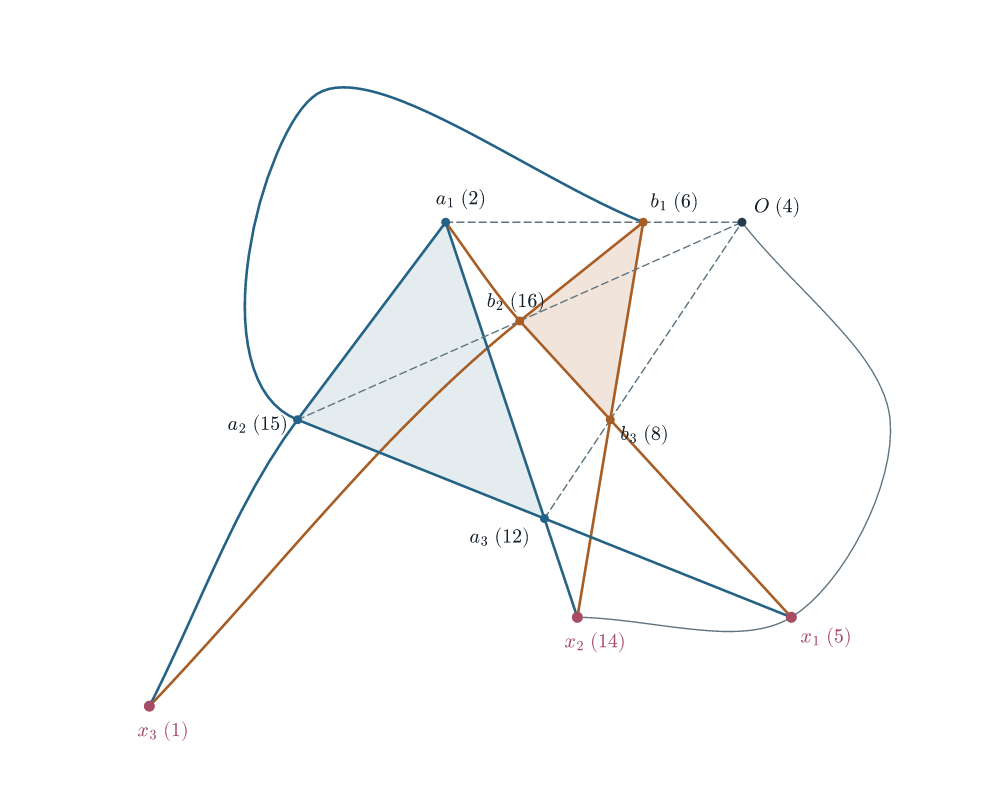
GPT solved this problem in the best way possible. It found a sequence of six Ingleton–Main extensions (which is slightly different from Larson–Le’s). It used linear programming more intensively to determine which further ranks are fixed in any admissible extension by combining the submodular inequalities, the known original ranks, and the equations granted by Ingleton–Main. After six extensions it has a polyhedron worth of possible polymatroid extensions. We view this as a partially defined polymatroid. The marvel is now that there is a specific contraction followed by a restriction which produces a fully and uniquely determined 10-element matroid violating the planar Desargues theorem. Thanks to a recent result of Yashfe (Remark 19) we know that almost-entropic matroids cannot violate Desargues and this gives the desired contradiction.
The code
The proof is still computational and it relies on an LLM-written program. I spent some time reading it, suggesting simplifications (which the LLM carried out), and making sure that it does not cheat in the verification. It is now quite small and easy to read. But you should see for yourself at the repository: larson-le-not-aent/im_projection.py.
The highlights of this construction in brief:
This proof replaces one Ingleton–Main extension by an invocation of Desargues’s theorem. It circumvents the enumeration of matroid extensions and the resulting case distinction by pointing out a minor of the partially known extension which is fully known and yields the contradiction.
Verification of this proof is super fast: 1.62 seconds on my laptop using 61 MiB of memory. The code is easy to audit and uses only standard library Python. The LLM came up with a nice compression technique to store polymatroids in terms of their flats. Instead of storing a rank value for each one of the subsets, it stores a closure operator and one rank for each closed set. This seems obvious in hindsight but I never used it before. This encoding is especially efficient when the number of closed sets is small.
In our scenario, after six Ingleton–Main extensions we have a partially defined polymatroid on a 16-element ground set which a priori means storing 65,536 ranks, some of which are unknown. Instead, we compute a closure operator based on the rank information we can determine. (This coarsens all possible closure operators in the sense that if is a polymatroid compatible with the partial ranks then its closure operator satisfies for all . In other words: dependencies we can detect through will always remain in every extension, but different extensions may introduce additional dependencies.) Each closed set comes with an interval of possible values whose lower and upper bounds can be certified by linear programming. If the bounds agree, the rank of that set is fixed and will remain fixed in every extension (even if the set ceases to be closed).
Our 16-element partial polymatroid has 223 flats of which 215 have certifiably fixed ranks. This covers enough of the entire polymatroid to compute the Desargues-violating minor.
The Larson–Le matroid is thus almost-entropic (because algebraic) with a non-almost-entropic dual. The only other explicitly known example of this phenomenon was constructed by Csirmaz based on an example of Kaced. That example has a ground set of 175 elements. GPT claims that it can distill their technique to produce an example on 69 elements of rank 38. This is still very far from Larson and Le’s example which is on only 10 elements and of rank 6.